
Drivers
Drivers are those road users travelling on our roads in charge of a vehicle. Drivers have a legal duty to follow the rules of the road and hold a valid driver’s licence and insurance.
Additionally, if a driver is the registered owner or keeper of a vehicle, they have a legal responsibility to ensure it is roadworthy with a valid MOT, adequately insured and taxed.
This section hosts a useful collection of free resources and links, with specific dedicated sections for Young Drivers, Older Drivers and Work Related Driving.

The Highway Code: 8 changes you need to know
Are you aware of the changes made to The Highway Code this year? Rules for all types of road users have been updated in The Highway Code to improve the safety of people walking, cycling and riding horses. Read more about it here.

Driving while using a mobile phone – changes to the law
Are you aware of the changes made to the law around using a mobile phone while driving? It is now illegal to use a hand-held device such as a phone, sat nav, tablet, or any device that can send or receive data, while driving or riding a motorcycle. Read more about it here.

Winter Driving


What3words
What3words has given every 3 metre square in the world a unique identifier made of 3 words – making the location of any emergency (999) or non-emergency (101) incident very easy to describe and share.
To report an incident or hazard using what3words, follow these three steps:
1. Download (or open) the free what3words app.
2. When you are at the location of the incident, open the app and tap the arrow icon (iOS) or compass (Android) for your current location.
3. Dial 999 (emergency) or 101 (non-emergency) and read the 3 words displayed on the app screen to the call operator.
Ensure you have the free what3words app:
https://app.what3words.com/e/MYdsNJWxbYb

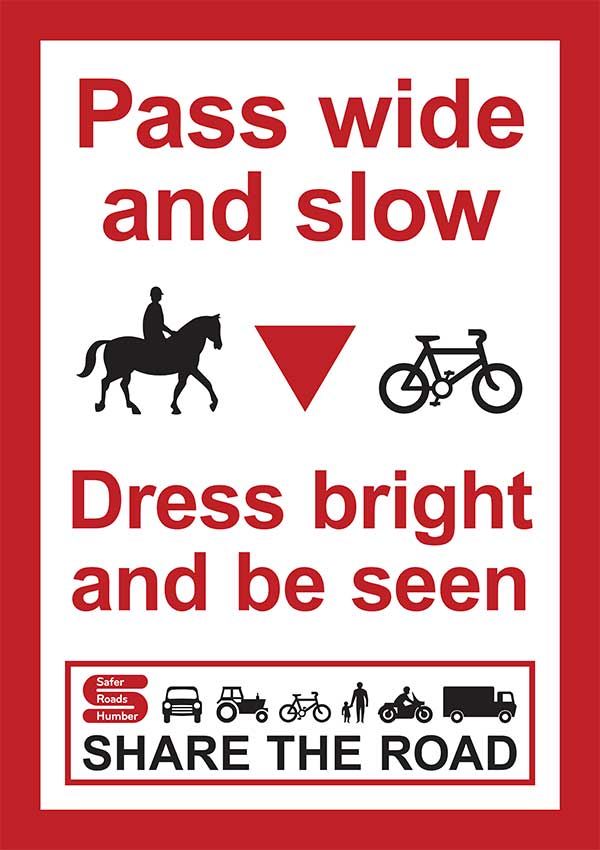
The British Horse Society’s Top Tips for Passing Equestrians Safely
• On seeing a horse on the road (whether ridden, driven or led), please slow down to a maximum of 10mph and allow at least two metres of space, as set out in the Highway Code.
• Heed a rider or carriage driver’s signal if they ask you to stop or slow down.
• If a rider or carriage driver is signalling to turn, wait patiently for them to complete their manoeuvre before continuing your journey. If the horse(s) shows signs of nervousness as you get closer, please stop and/or turn the engine off and allow them to pass.
• Please don’t start your engine or move off again until the horse(s) is clear of the rear end of the vehicle.
• If a road is narrow and there is not enough room to pass safely, please approach slowly, or stop to give them time to find a gateway or other place off the road where there will be enough space between the horse and vehicle to allow you to pass safely.
• Please be patient. Most equestrians will do their best to reassure their horses and will allow you to pass as soon as it’s safe to do so.
• The safest place for the rider’s hands is on the reins, so they may only be able to nod their thanks to you – but please be assured that they will be very grateful for your consideration.
• Look out for equestrian road signs – these signs indicate you are likely to encounter a horse on your journey.
Driving Speed limits
Legal speed limits vary depending on the road and vehicle being driven. Never exceed the limits that apply to your vehicle and be mindful and understanding of the limits for other vehicle types.

National Highways
National Highways, formerly Highways England, and, prior to that, the Highways Agency, is a government-owned company charged with operating, maintaining and improving motorways and major A roads in England.

The Highway Code
The Highway Code is essential reading for road users and applies throughout the UK, with some variation in relation to Northern Ireland. Take some time to refresh your memory.


Car Seat Safety
If you want to learn more about in car child safety, including choosing, buying and fitting a car seat, click here for more information on Good Egg Safety.


